
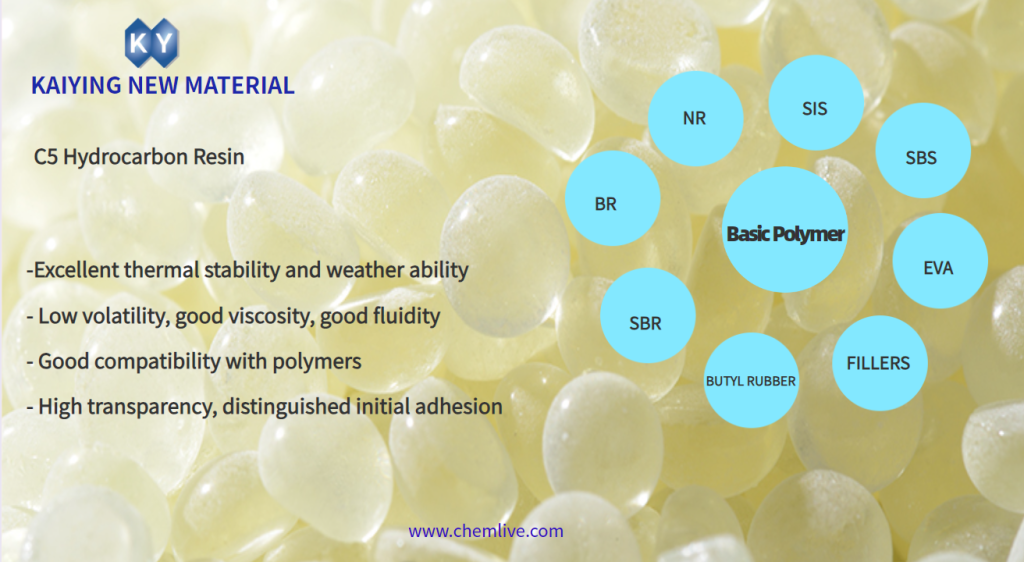
C5 resin has an aliphatic structure and follows the “like dissolves like” rule — it is highly miscible with aliphatic or low-polarity polymers. When the base polymer’s polarity is close to that of the resin, the two phases mix at the molecular level, producing a uniform, transparent film with stable tack and cohesive strength.
Compatibility Overview by Polymer Base
SIS (Styrene-Isoprene-Styrene) Block Copolymer
Applications: PSAs, labels, tapes
Notes: Best compatibility; resin fully integrates into the isoprene mid-block
SBS / SIBS
Applications: HMAs, footwear, construction adhesives
Notes: Good compatibility; hydrogenated C5 grades perform even better
SEBS / SEPS (Hydrogenated Styrenic Block Copolymers)
Applications: Hygiene HMAs, automotive HMAs
Notes: Excellent thermal stability when paired with C5
Natural Rubber (NR) / Polyisoprene (IR)
Applications: PSAs, rubber compounding
Notes: Classic tackifier combination
Butyl Rubber / EPDM (Ethylene Propylene Diene Monomer)
Applications: Tire inner liners, sealants
Notes: C5 acts as both a processing aid and tackifier
Low-VA EVA (typically <18–20% vinyl acetate)
Applications: Packaging, bookbinding HMAs
Notes: Low VA content keeps the matrix sufficiently non-polar
EnBA (Ethylene-n-butyl acrylate)
Applications: HMAs, flexible packaging
Notes: Fully compatible
APAO (Amorphous poly-α-olefins)
Applications: HMAs, road marking, wax blends
Notes: Highly miscible due to similar aliphatic nature
Polyethylene (LDPE / LLDPE / HDPE / mPE)
Applications: Film modification, masterbatches
Notes: Metallocene PEs show especially good miscibility
Polypropylene (PP / mPP)
Applications: Modified PP sheets, automotive parts
Notes: Helps improve rigidity and barrier properties
PIB (Polyisobutylene) / OBC (Olefin Block Copolymers)
Applications: Sealants, TPE compounds
Notes: Compatible in practical proportions
Paraffin & Microcrystalline Waxes
Applications: Candles, coatings, wax blends for adhesives
Notes: Fully soluble